A detailed overview of traditional and rugged off-road vehicle chassis.
In the automotive world, body design and body type play a critical role in performance, safety, durability, and even comfort. There are two main approaches to body construction: frame construction and monocoque construction. While most cars and crossovers today use monocoque bodies, the ladder-frame platform is still commonly used in SUVs, pickup trucks, and heavy-duty trucks. In this article, we’ll use simple technical terms to explain what a ladder-frame platform is, how it works, its advantages and disadvantages, and why it’s so popular in the automotive industry.
Determining the platform of the stair frame
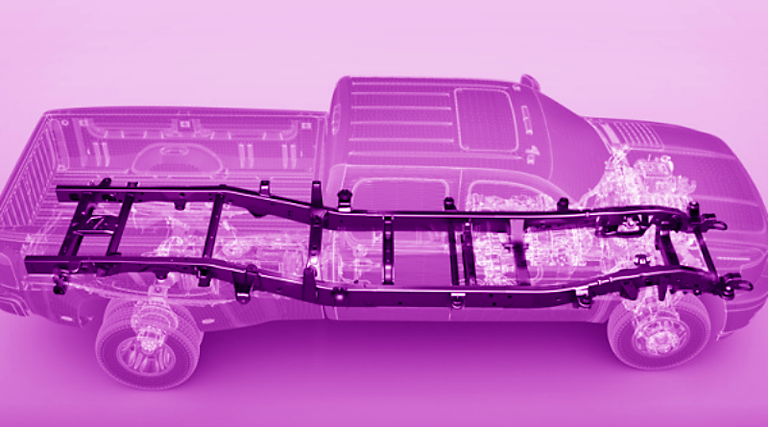
As the name suggests, the vehicle body is mounted on a separate frame, which in turn sits on a ladder-like platform. This frame typically consists of a parallel steel beam connected to a cross member, giving it a trapezoidal shape. The body, engine, suspension, and other components are mounted on this frame, while the chassis is responsible for absorbing the loads, shocks, and stresses encountered during driving.
The ladder frame is essentially the mechanical heart of the vehicle and serves as a solid foundation for other components, such as the body. This design has been used in heavy-duty, military, and off-road vehicles for decades and remains one of the most durable to date.
History and development
The ladder frame is one of the oldest construction methods in automotive engineering. By the early 20th century, this design was already used in virtually all vehicles, primarily due to its simplicity and ease of manufacture. As the automotive industry evolved, companies strove for weight reduction, fuel efficiency, and improved ride comfort. This led to the development of the monocoque body.
However, SUVs, trucks, and vans continue to use ladder frames because their high torsional rigidity and high load-bearing capacity are crucial for these vehicles. Many popular models, such as the Toyota Hilux, Ford Ranger, Nissan Patrol, Land Cruiser, and Mercedes-Benz G-Class, still use ladder frames today.
The main components of a stair frame
-
Side members:
These are the two main members located on either side of the frame and serve as the foundation of the vehicle. -
Cross sections:
These steel profiles are located between the longitudinal beams and offer greater torsional and bending strength. -
Mounting points:
The places where the frame, engine, suspension, and other components are attached to the chassis. -
Materials:
They are usually made of durable steel, but newer models also use lighter alloys such as aluminum to reduce overall weight.
Together, these components form a structure that acts as a strong frame to support the weight of the vehicle and the forces generated during movement and impact.
How does it work?
In vehicles with ladder frames, the main frame bears and distributes all physical stresses from the road, engine, and cargo. The frame serves only a protective and aesthetic function and cannot withstand high mechanical stresses.
When driving off-road, the frame absorbs vibrations and shocks, preventing them from being transmitted to the cabin. Therefore, this platform is often used in military vehicles and SUVs operating in harsh conditions.
Design features of the stair platform
1. High strength and good durability.
One of the key advantages of this design is its high bending and torsional strength. This property allows the vehicle to withstand high loads without damaging the main structure.
2. Suitable for off-road use.
Rocky, rough, and uneven terrain places considerable stress on the chassis. Thanks to its trapezoidal design, the vehicle can withstand these loads without deforming or being damaged.
3. Easier maintenance
Because the frame is separated from the chassis, damaged components can be repaired or replaced individually. This feature is particularly useful for military and industrial vehicles.
4. High scalability
Ladder-frame vehicles are very popular with off-road and tuning enthusiasts. This platform can easily accommodate metal bumpers, lifting devices, higher suspension, or larger tires.
5. Safety when moving heavy objects
In both small and large trucks, the load rests directly on the frame rather than on the loading area. This distributes the weight evenly and increases the vehicle’s stability against tipping.

Disadvantages of a ladder frame platform
1. Weight gain
The use of thick steel sheets and a large number of components increases the weight of the vehicle, which increases fuel consumption and reduces overall efficiency.
2. Higher center of gravity
Placing the vehicle body on an independent chassis increases the height of the vehicle, which shifts the center of gravity upwards and reduces the vehicle’s cornering stability.
3. The handling is worse than that of a car with a monocoque body.
In passenger cars, maneuverability and cornering stability are crucial. A trapezoidal body doesn’t absorb lateral forces as well as a monocoque body, and its handling is somewhat worse at high speeds.
4. Low safety in the event of an accident
In the event of a traffic accident, a vehicle with a self-supporting body can better absorb the impact energy, while a trapezoidal body transfers part of the impact force directly into the passenger compartment, which can be more dangerous for passengers.
5. The interior is smaller than the exterior dimensions.
Since the body is mounted on the chassis, the ground clearance of the car increases and the free space in the cabin decreases.
Comparison of ladder frame and monocoque frame
| Special feature | Trapezoidal structure | Monocoque construction |
|---|---|---|
| Building | Body on an independent frame | Monocoque and chassis |
| Weight | Heavier | lighter |
| Off-road capability | very large | half |
| Control over the city | weaker | better |
| Production costs | fewer | additionally |
| Editing functions | higher | limited |
| Driving comfort | fewer | additionally |
| Common applications | Small trucks, SUVs and vans | Passenger cars and crossovers |
As the table shows, both body types have their advantages and potential uses. The choice between the two depends on the vehicle’s intended use.
Current applications
The ladder frame platform is still used in many modern vehicles. Here are some of the most popular examples:
-
Toyota Land Cruiser and Hilux : symbols of durability and the ability to handle difficult roads.
-
Ford Ranger and Bronco: a combination of traditional strength and modern technology.
-
Nissan Patrol and Navara: classic examples of Japanese power.
-
Mercedes-Benz G-Class : one of the world’s most luxurious SUVs with a trapezoidal frame.
This design is still used on many trucks, ambulances and military vehicles.
The future of staircases
Despite the growing global trend toward lighter vehicles and the shift to electric vehicles, a ladder-frame platform is not an impossible solution. Companies are striving to reduce weight while maintaining strength by using modern steel and aluminum alloys.
Some hybrid and electric SUVs also use this design to support the weight of the battery and the stresses associated with off-road driving. So, despite its long history, the ladder frame is evolving and will retain its position in the SUV and heavy-duty vehicle segment.
Finally
Body-on-frame (BOF) construction is one of the oldest and most durable vehicle construction methods. Despite its high weight and fuel consumption, it is characterized by exceptional strength, durability, and reliability. That’s why it is still used today in SUVs, pickup trucks, and vans.
If you’re looking for a vehicle suitable for off-roading, heavy haulage, or active recreational activities, a ladder frame is the ideal choice. However, if comfort, fuel efficiency, and a smooth ride are important to you, a monocoque vehicle is the perfect choice.
Ultimately, both types of platforms play an important role in the automotive industry and the choice between them depends on your requirements, application and taste.