Off-road vehicles, including SUVs and four-wheel-drive pickups , are designed for reliable and consistent performance under a wide range of road conditions, such as rough terrain, steep slopes, mud, rocks, and deserts. A key element of these vehicles is the transmission ; it transfers power directly from the engine to the wheels, thus determining driving performance in different situations.
In recent years , most major automakers, such as Toyota, Jeep, Ford, Mercedes-Benz, and Land Rover, have fitted eight-speed transmissions to their off-road vehicles. But the question remains: Why eight gears? Why not fewer or more? Below, we examine the technical and engineering reasons behind this decision.
1. Different gear ratios to improve the vehicle’s maneuverability in difficult terrain.
One of the main reasons for using an eight-speed gearbox is the wide range of gear ratios .
On challenging sections of road, the driver needs precise control of engine torque and speed, adapted to the specific conditions. At low speeds, more torque is transmitted to the wheels, which is crucial when driving uphill, on uneven terrain, or in mud.
The eight-speed gearbox allows the driver to select the optimal and most efficient gear in every situation . This enables the engine to operate within its optimal torque range and achieve a balanced ratio between fuel consumption and performance.
In short, for SUVs, “precise torque control” is more important than “top speed”, and more gears can improve this control.
2. Reduce fuel consumption on highways
Although SUVs are typically designed for off-road use, they are also frequently used in city traffic and on highways. In such situations, the higher gears of the eight-speed transmission prove extremely useful.
In seventh and eighth gear, the gear ratio is significantly lower, which reduces the engine speed at high speeds. This has two important advantages:
-
Reduced fuel consumption
-
Reduces engine wear and the noise level in the interior.
For example, the engine speed of a car equipped with an 8-speed gearbox can drop to 1,800 rpm at a speed of 100 km/h, while the engine speed of the same car with a 5-speed gearbox should be between 2,500 and 3,000 rpm.
These small differences can have a big impact on fuel consumption and engine lifespan.
3. Smoother transitions and faster response times
Nowadays, electronics play a key role in transmission systems. This eight-speed transmission uses a highly advanced torque converter and an electronic control unit (TCU) that intelligently determines the optimal shift points based on driving conditions.
Drivers can therefore expect faster, smoother gear changes and less vibration . This is particularly important when driving on uneven roads or over rocky obstacles, as even the slightest bump or delay in power transmission can lead to a loss of vehicle stability.
In contrast to the slow gear changes typical of multi-speed transmissions of the past, today’s eight-speed transmission is fast and intelligent thanks to the use of new technologies such as Quick Shift and Adaptive Transmission Logic.
4. Improved compatibility with all-wheel drive (4WD) systems.
SUVs are typically equipped with all-wheel drive, either permanent or optional. In these systems, the transmission must ensure an even distribution of power between the front and rear axles.
Thanks to its eight-speed gearbox and wider gear ratio spread, the vehicle offers excellent driving performance in this respect. When driving on sand, snow, or deep mud, the more precise gear selection ensures optimal power distribution between the wheels, thus reducing the risk of getting stuck.
Furthermore, in many modern vehicles, the transmission works in conjunction with traction control and the electronic stability program (ESP) . The more gears, the more evenly the torque is distributed to the wheels.
5. More power can be achieved without increasing the engine’s displacement.
Previously, manufacturers had to use more powerful engines (such as 5- or 6-liter V8s) to increase the power and torque of SUVs. However, thanks to advances in modern transmissions, the same performance can now be achieved with smaller engines.
The eight-speed transmission allows the engine to maintain optimal torque under various operating conditions. For example, the vehicle can intelligently shift gears when driving uphill, thus maintaining power without loss.
For this reason, even vehicles currently equipped with 2.0 or 3.0 liter turbo engines can achieve the performance of older engines with larger displacement.
6. Characterized by high strength and resistance to adverse conditions.
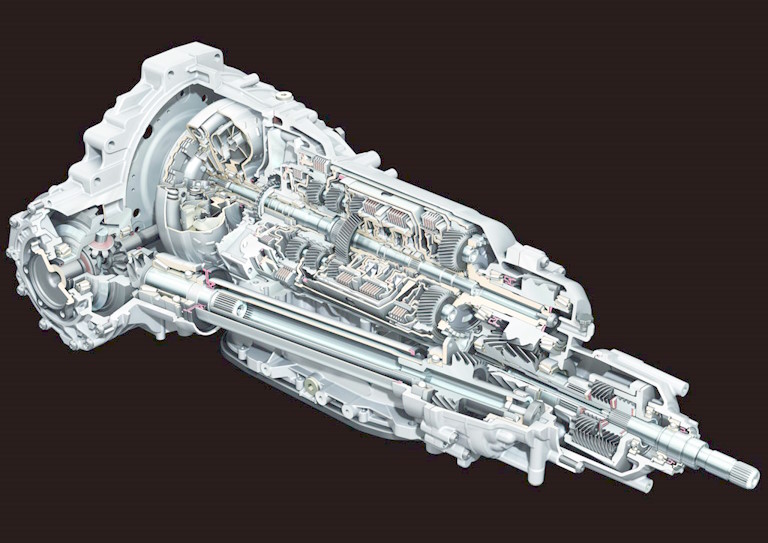
Transmissions designed for off-road use must be extremely robust, as they have to withstand the enormous stresses encountered in rough terrain. Modern eight-speed transmissions , such as the ZF 8HP, which is used in the Jeep Wrangler, Toyota Land Cruiser, BMW X5, and Ram 1500, are manufactured using special technology.
-
They use lightweight yet extremely robust steel components .
-
Features independent transmission oil cooling systems.
-
It uses a highly advanced multi-disc clutch that can withstand high engine torques.
Thanks to these properties, the eight-speed gearbox can withstand torques of over 900 Newton meters without damage or overheating.
7. Full integration with electronic systems and intelligent driving.
Modern SUVs are equipped with various driving modes, such as “Sand,” “Rock,” “Mud,” “Snow,” and “Economy .”
The eight-speed transmission intelligently adjusts the gear ratios and shift patterns to the selected driving mode. For example:
-
In Rock mode, the transmission is locked in a lower gear to generate higher torque.
-
In energy-saving mode, gear changes occur earlier, thereby reducing fuel consumption.
-
In Sport mode, the transmission reacts more directly and quickly.
This versatility can only be achieved with a gearbox with a large number of gears.
8. Why not use a 10-speed gearbox?
One might ask: If an eight-speed gearbox is sufficient, why do some cars use a ten-speed gearbox?
The answer lies in off-road capabilities .
In sports cars or high-performance pickups (like the Ford F-150), a ten-speed transmission contributes to lower fuel consumption and better acceleration. In SUVs, however, the optimal balance between the number of gears, torque, and responsiveness is more important.
Transmissions with more than eight gears generally require more gear changes and can cause vibrations or jerking when driving off-road. Eight gears therefore offer the optimal balance between performance, smoothness, and reliability .
In conclusion
The eight-speed transmission in this SUV is the result of years of experience and development
in transmission design. This system offers several advantages:
-
Precise engine torque control on uneven roads
-
Reduced fuel consumption on the road
-
The gear changes are smooth and quick.
-
Offers excellent compatibility with all-wheel drive systems.
-
High strength and resistance to adverse conditions
For this reason, most major SUV manufacturers use this type of transmission. The eight-speed transmission offers the perfect combination of performance, intelligent control, and reliability for off-road use.